
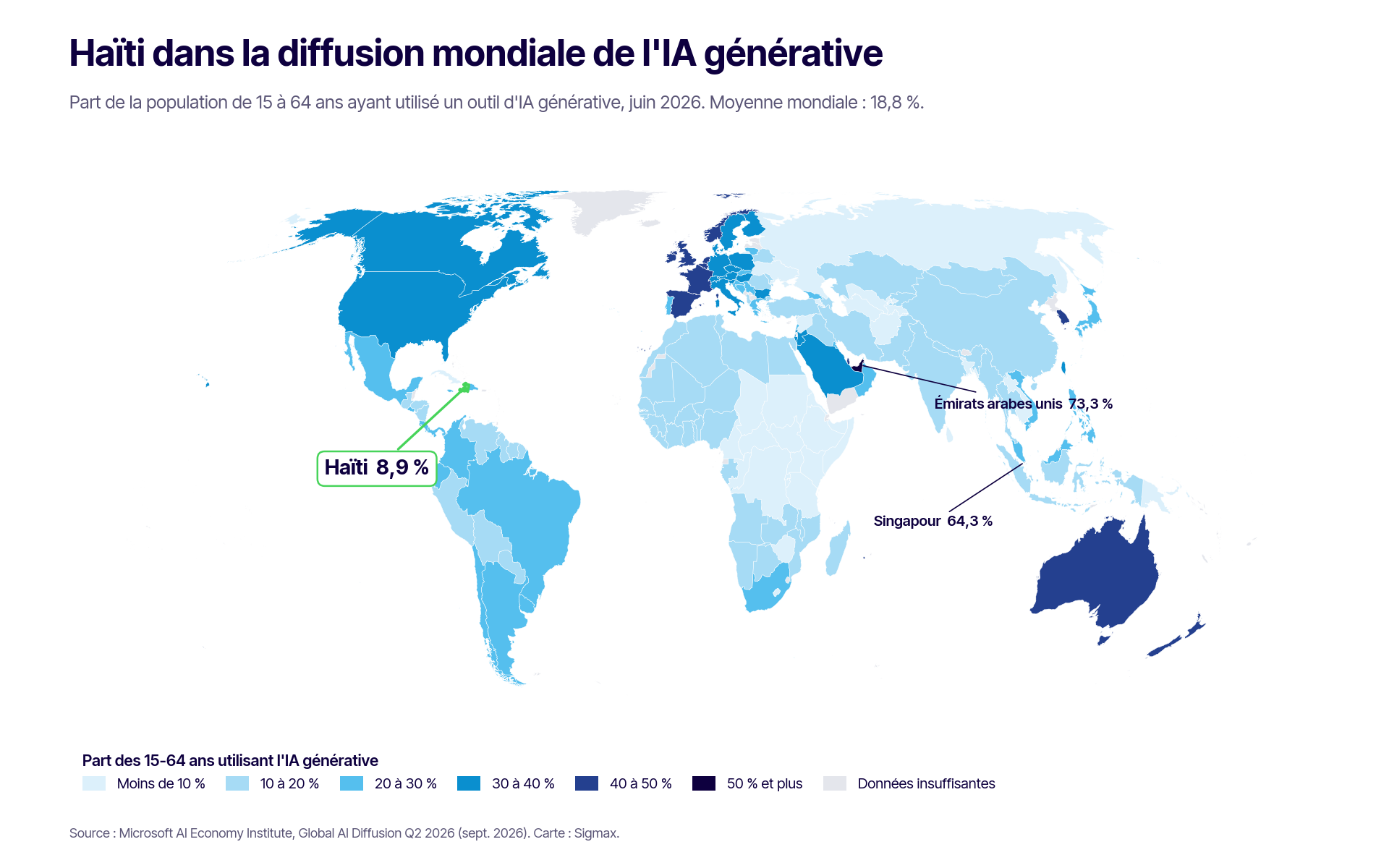
In June 2026, 8.9% of Haitians aged 15 to 64 had used a generative artificial intelligence product, according to estimates published in September by the Microsoft AI Economy Institute in its report Global AI Diffusion: Q2 2026 Trends and Insights. That rate is less than half the world average (18.8%) and well below the Global South average (16.2%). It places Haiti around 124th of 147 economies, level with Kenya and Zimbabwe, and second lowest in the Americas. The finding is not only about the level: diffusion is advancing in Haiti, but too slowly to narrow the gap with the rest of the world.
Strong global adoption, a widening North-South divide
Between the first and second quarters of 2026, the share of the world's working-age population using generative AI rose from 17.8% to 18.8%. The increase touches almost every economy, but it benefits first those that were already furthest ahead. The United Arab Emirates (73.3%) and Singapore (64.3%) keep the top of the ranking, and South Korea records the quarter's largest gain (+3.5 points).
The gap between the Global North (28.8%) and the Global South (16.2%) now stands at 12.6 points, up from 10.6 points in the second half of 2025. For the time being, the diffusion of generative AI therefore follows a cumulative logic: the economies best endowed with digital infrastructure and human capital capture most of the adoption gains.
Haiti: a rising level, a widening gap
Haiti's rate rose from 8.5% to 8.9% in one quarter, an increase of 0.4 points, against 0.8 points for the Global South and 1.0 point worldwide. The gap with the world average thus widened from 9.3 to 9.9 points, and the gap with the Global South from 6.9 to 7.3 points.
The problem is therefore not the absence of progress but its pace. At the observed speed, Haiti would need about six years to reach the current world level, which will itself have kept rising. This linear extrapolation is not a forecast; it gives the measure of the lag and shows that it will not close on its own.
The Caribbean, a two-speed basin
The four Caribbean island economies published in the table fall into two clearly distinct groups. The Dominican Republic (25.8%) and Jamaica (25.0%), each gaining 1.0 point, sit above the world average. Haiti (8.9%, +0.4 points) and Cuba (6.8%, +0.1 points) remain far behind. Around the rim of the basin, Costa Rica (29.7%), Colombia (25.9%) and Panama (24.2%) belong to the first group.
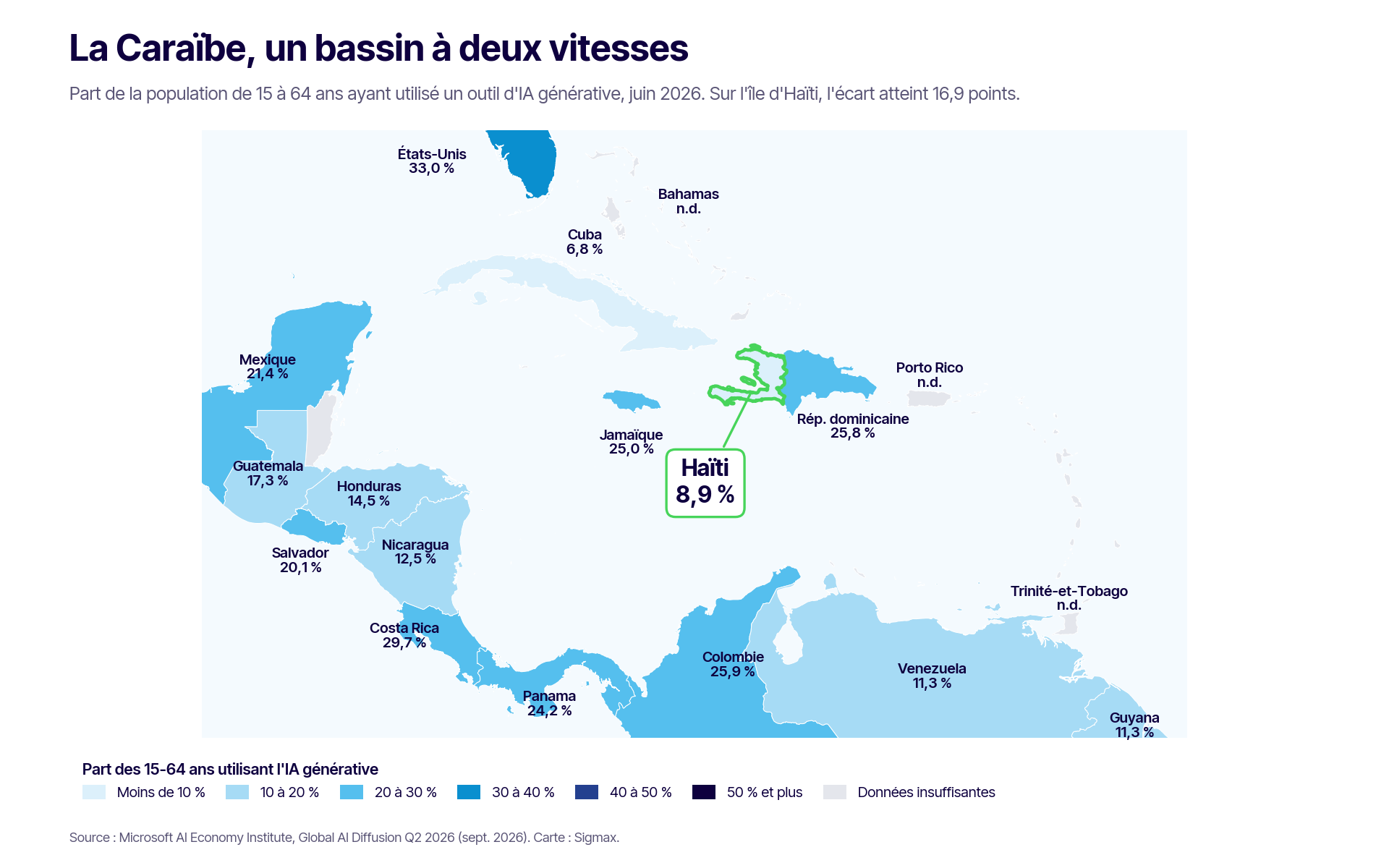
The most telling contrast is on the island of Haiti, where the Dominican rate is nearly three times the Haitian one. In a single quarter, the gap between the two countries grew from 16.3 to 16.9 points. For two economies competing directly for investment, outsourcing and skills, a divergence in adoption of that size risks turning, over time, into a gap in productivity and attractiveness.
These four countries cannot stand in for a Caribbean average, however: most of the region's small island states have no published national estimate.
What the indicator measures, and what it does not
Microsoft's figure is neither a national survey nor a census of users. It is built from anonymised telemetry data, drawn mainly from desktop usage, then adjusted for the market shares of operating systems and devices, mobile usage, internet penetration and population. The authors acknowledge that some of these assumptions, notably on overlap between devices, are hard to validate.
The methodology also provides for regional groupings when an economy's population or traffic does not allow a robust national estimate. The annexes bear the mark of it: twelve West African economies show exactly the same rate (10.4%), as do eight East African economies (8.0%) or Guyana, Suriname, Venezuela and French Guiana (11.3%). Haiti's trajectory is itself identical to Zimbabwe's, which calls for a cautious reading of the national figure.
Above all, the indicator measures diffusion, not the intensity or quality of use. It says nothing about professional use, the tasks transformed or productivity gains. Microsoft also announces a broader set of covered tools from the next edition, which will mechanically raise the measured rates. The Haitian level should therefore be read as an order of magnitude, useful for placing the country and tracking its relative progress.
Two routes to catching up: learning and open models
The analysis of a sample of consumer Copilot conversations highlights a particularity of usage in the Global South. Self-directed learning and skills development account for a share of conversations 29.2% higher than their share worldwide, and school and university support for a share 32.3% higher. The authors attribute this partly to a younger population and note that these results concern early adopters. In Haiti, where the population is young and the education system severely constrained, this orientation makes AI a potential vehicle for building human capital, even before it becomes a factor of production.
The second route lies in the economics of models. Open-weight models, which anyone can download and adapt, reach within months a performance close to that of the best proprietary models; some deliver results comparable to recent closed systems for about a third of the cost per task. They now account for 75% of the tokens processed on OpenRouter, a platform used mainly by developers. Their openness also makes adaptation to low-resource languages easier: the Bring Your Own Language framework from the Microsoft AI for Good Lab improved performance in Chichewa and Māori by about 12% on average across the tests studied.
These results do not concern Haitian Creole and do not transfer to it automatically. They nevertheless point to a path: corpora, test sets and evaluations designed in Haiti, rather than reliance on general-purpose multilingual models whose command of Kreyòl and of the local context remains to be demonstrated.
Four priorities for Haiti
The report documents the diffusion of AI, its uses and the potential of open models; it makes no recommendations specific to Haiti. The directions that follow are Sigmax's own reading. Haiti's lag stems first from structural constraints: access to electricity, coverage and cost of connectivity, the level of digital skills. No AI strategy can substitute for them, but four lines of work can begin without waiting for those constraints to be fully lifted.
- Measure. Build a national measure of AI use, covering the tools used, frequency, user profiles, the tasks involved and the obstacles encountered. A dedicated module in household and enterprise surveys would allow disaggregated tracking by territory, age, sex and sector of activity.
- Train. Make education, vocational training and self-directed learning the priority grounds for experimentation, so as to turn the main entry point observed in the South into a lasting gain in human capital.
- Localise. Invest in corpora, test sets, tools and evaluations in Kreyòl, in partnership with universities and the diaspora.
- Organise. In businesses and institutions, frame adoption around precise use cases, data security and measurable results, assigning each task to the least costly model able to perform it correctly.
For Haiti, the challenge is therefore twofold: speeding up access and understanding usage better. The diffusion of generative AI plays out over a short horizon; without deliberate action, the current gap risks hardening into a lasting differential in productivity, employability and attractiveness.
Source
Microsoft AI Economy Institute, Global AI Diffusion: Q2 2026 Trends and Insights, September 2026. Methodology: Misra, A. et al. (2025), Measuring AI Diffusion: A Population-Normalized Metric for Tracking Global AI Usage. Data: AI Diffusion dataset, Q2 2026 update. Maps and calculations: Sigmax. Maps are in French.