
In 2024-2025, the Haitian government spent more without investing more. Executed expenditure rose by 34.1% in nominal terms, but programmes and projects were carried out at only 46.8% of appropriations, and the deficit of 22.6 billion gourdes (bn G) corresponds almost exactly to the debt repayment made in excess of the voted appropriation (22.5 bn G).
- An economy sinking further. A seventh year of recession (real GDP -2.7%, a cumulative -16.1% since 2018-2019) and end-of-year inflation of 31.9%, against targets of +1.0% and 19.1%.
- A fiscally exhausted government. Current revenue fell to 4.5% of GDP, its lowest level in seven fiscal years; in real terms it declined by about 13%, and customs revenue by about a third.
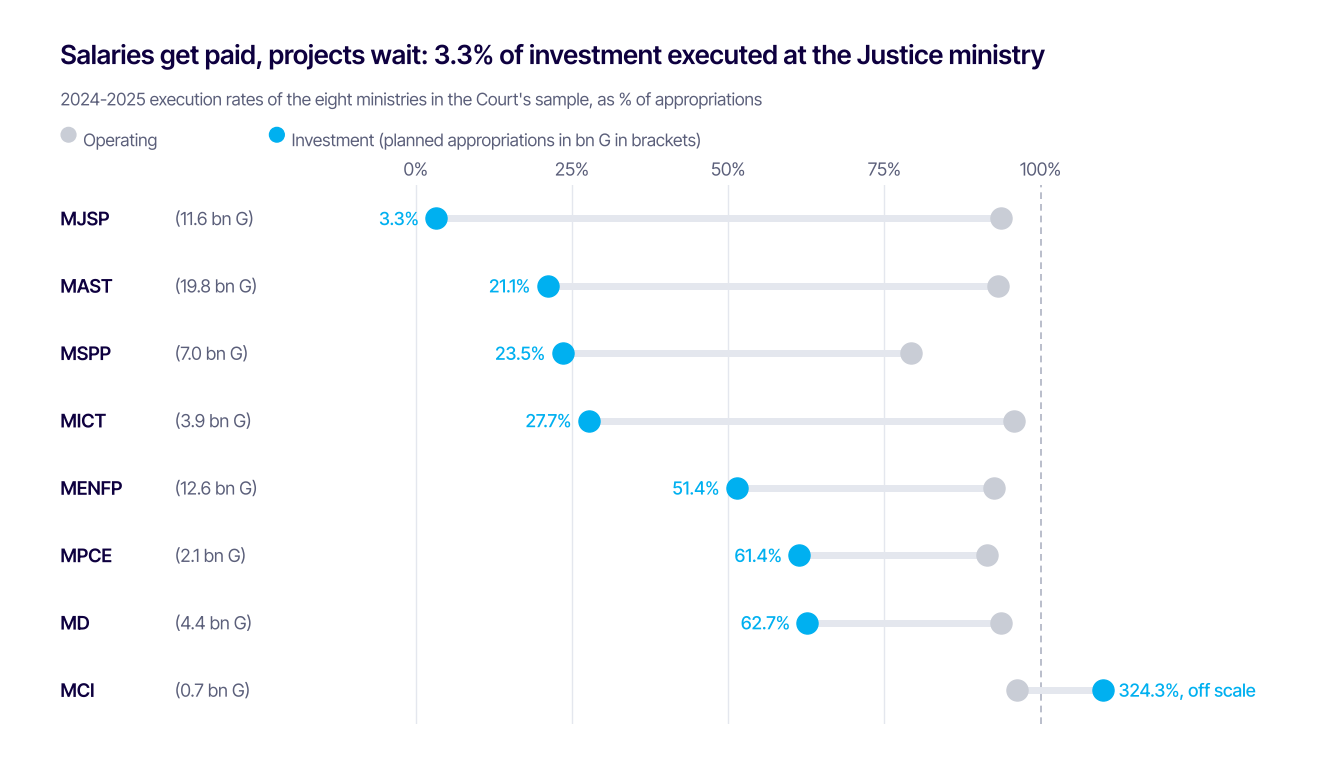
- Two-speed execution. Operating expenditure was executed at 104.4%, programmes and projects at 46.8%, and the investment budget of the Ministère de la Justice et de la Sécurité publique (MJSP, the justice ministry) at 3.3%, although security was the budget's first priority.
- Debt that is being restructured more than reduced. The debt-to-GDP ratio (8.7%) is falling mainly because inflation is inflating nominal GDP; financing is shifting from the Banque de la République d'Haïti (BRH, the central bank) to Treasury bills (+52.5%), held by banks whose profits rose by 32.1% while real credit to the private sector contracted by about 21%.
- Management without checks and balances. A budget set by decree, two amendments, the second one seven days before year-end, no Parliament in office since January 2023, and a general account submitted to the Court more than nine months after the end of the fiscal year.
Real-terms changes are calculated using average inflation for the fiscal year (28.3%); dollar conversions use the average rate of 130.7 gourdes to the dollar.
Purpose and scope of the report
The twelfth Rapport sur la situation financière du pays et sur l'efficacité des dépenses publiques (RSFPEDP XII, the annual report on public finances) is produced by the Cour supérieure des comptes et du contentieux administratif (CSCCA, Haiti's supreme audit institution) under Article 204 of the Constitution. It covers the fiscal year from 1 October 2024 to 30 September 2025 and relies mainly on the Compte général de l'administration centrale de l'État (CGACE, the central government's annual accounts), supplemented by data from the Institut haïtien de statistique et d'informatique (IHSI, the national statistics office) and the BRH.
The report is organised in three parts: the economic context and budget execution, a set of indicators of financial sustainability, flexibility and vulnerability, and finally the efficiency of spending, assessed against the macroeconomic targets and on a sample of eight ministries accounting for 49.0% of appropriations.
Three limitations shape how the document should be read.
- Oversight with no one to receive it. The report is addressed to the Legislature, which has not been in office since January 2023, the Chamber of Deputies having lapsed in 2020; the budget itself was set and amended by decree.
- Late and poorly disaggregated information. The general account was only transmitted on 6 July 2026, and the Court acknowledges that it cannot match spending to physical outputs, for lack of indicators and targets.
- Figures that do not always reconcile. Debt service is given as 13.9 bn G in point 2.2.1 of the second part, against 39.3 bn G of amortisation in the first; execution at the Ministère des Affaires sociales et du Travail (MAST, the social affairs ministry) appears as 26.0% and then 28.4%; public debt is executed at 39.4 bn G against 18.0 bn G of appropriations (an overrun of 21.4 bn G) in point 2.5.2, against 39.3 bn G for 16.8 bn G (22.5 bn G) elsewhere; finally, the 72.5 bn G fall in BRH claims on the Treasury is not explained (repayment, conversion into securities or accounting operation). These discrepancies call for caution in reading the detail of debt flows.
Key facts of fiscal year 2024-2025
None of the quantified targets of the budget framework was met, except for the zero monetary financing required by the IMF staff-monitored programme.
| Indicator | Budget target | Outturn |
|---|---|---|
| Real GDP growth | +1.0% | -2.7% |
| End-of-year inflation | 19.1% | 31.9% |
| Current revenue | 5.0% of GDP (215.7 bn G) | 4.5% of GDP (189.0 bn G) |
| Investment from Treasury resources | 29.6 bn G | 20.9 bn G |
| Budget balance | Balanced | -22.6 bn G |
| BRH monetary financing | Zero | Zero |
A broad-based recession and inflation picking up again
Real GDP stood at 552.5 bn constant gourdes, against 658.3 bn in 2018-2019. All three sectors declined, with sharp falls in accommodation and food services (-21.1%), transport (-15.4%), electricity (-14.3%, with the Péligre plant shut down) and rice growing in the Artibonite (-19.0%). Gross fixed capital formation fell a further 15.3%, after -36.8% the previous year. Apart from information and communication (+3.5%) and financial activities (+5.6%), only public administration grew, and markedly so (+12.6%), which reflects the cost of the government more than the volume of services delivered.
Year-on-year inflation rose from 27.9% to 31.9%, even though the gourde appreciated slightly (130.7 gourdes to the dollar on average). According to the Court, the main drivers are insufficient domestic supply, armed groups extorting tolls on the roads, and the electricity shortage.
Resources up in nominal terms but down in real terms
Resources mobilised reached 245.1 bn G, or 77.2% of forecasts. Domestic revenue rose by 25.3% in value, customs revenue fell by 15.8%, and grants (31.2 bn G) reached only 45.9% of the budgeted amount. No external loan was drawn; direct budget support was limited to 62.7 million gourdes out of 2.8 bn G planned.
Spending driven by debt, investment rationed
Executed expenditure reached 267.7 bn G (84.3% of appropriations). Debt amortisation was paid at 39.3 bn G for 16.8 bn G voted (234.4%), while 59.1 bn G of appropriations for programmes and projects went unused. Overruns also affected the Ministère de l'Économie et des Finances (MEF, the finance ministry, +8.0 bn G), the Ministère du Commerce et de l'Industrie (MCI, the trade ministry, +1.5 bn G), energy subsidies (+1.4 bn G) and public interventions (+0.7 bn G).
A deficit financed by Treasury bills
The balance swung from a surplus of 6.4 bn G to a deficit of 22.6 bn G, the largest since 2020-2021. It was covered almost entirely by Treasury bills (22.9 bn G issued), whose outstanding stock rose from 47.4 to 72.3 bn G.
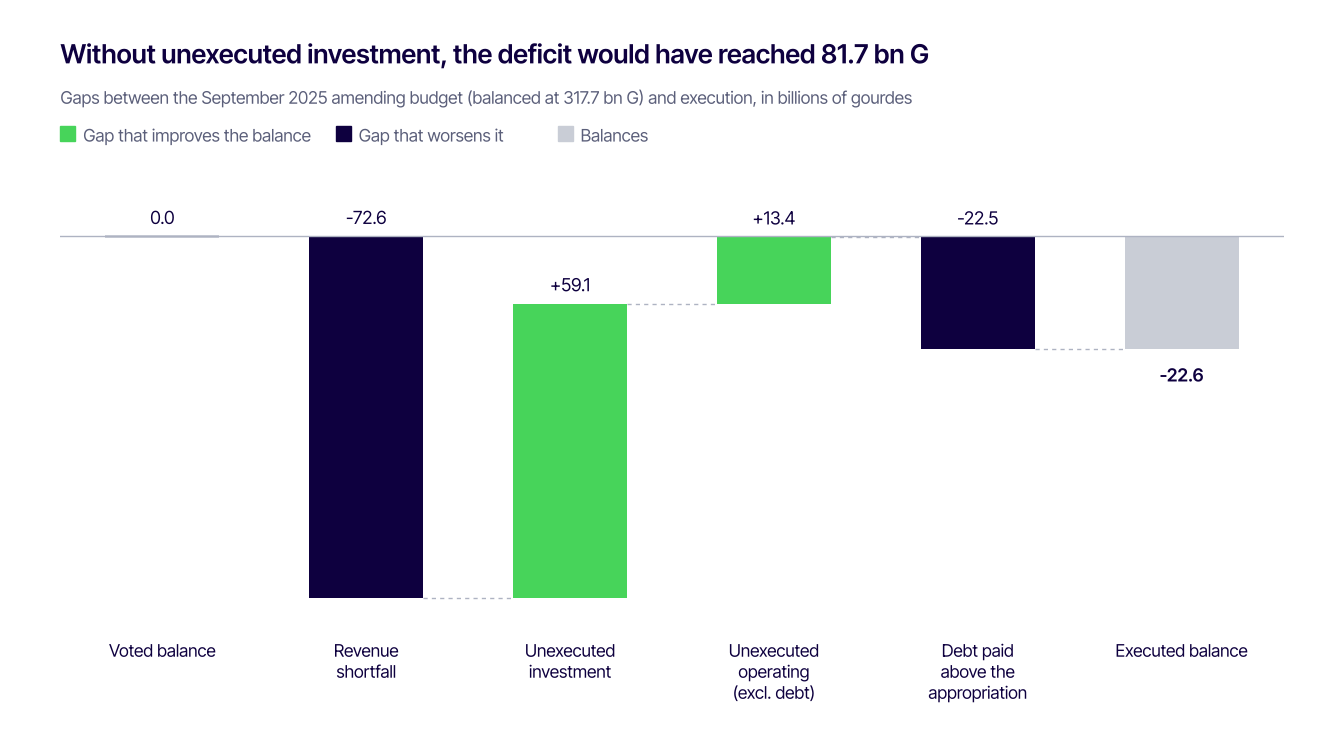
In practice, the budget was held together by squeezing investment: the revenue shortfall and the extra cost of debt (95.1 bn G in total) were absorbed for nearly two thirds by projects that were not carried out.
The economic risks
The 2024-2025 configuration feeds a vicious circle: insecurity depresses activity and revenue, the government adjusts through investment, and the lack of investment prolongs insecurity and contraction.
A lasting erosion of growth potential
With gross fixed capital formation down 15.3% after -36.8%, the stock of productive capital is deteriorating faster than it is being renewed. The cumulative loss of 16% of real GDP since 2018-2019 risks becoming structural: unmaintained roads, power grid and water systems, depreciated equipment, skills that emigrate. The longer recovery is delayed, the further away the recoverable level of GDP becomes.
Crowding out in favour of a rent-seeking banking system
Banks increased their holdings of Treasury bills by 38.4% and their deposits at the BRH by 16.7%, while credit to the private sector grew by 1.9% in value, a fall of about 21% in real terms. The sector's net profit (+32.1%, return on equity of 18.9%) therefore comes more from financing the government and the central bank than from productive intermediation. The improvement in non-performing loans (from 14.17% to 9.98% in one quarter) stems from the BRH moratorium and postpones a risk of losses rather than removing it.
A domestic debt refinancing risk
Debt is moving from a captive creditor, the BRH, to a market of short-term securities whose rate, maturity and repayment schedule the report does not publish. A government that raises 22.9 bn G in bills to repay 39.3 bn G of amortisation exposes itself to permanent rollover, and therefore to a rising interest bill as soon as bank liquidity tightens. The debt-to-GDP ratio of 8.7% is partly an artefact of inflation: if inflation slows, the ratio will mechanically rise again.
Inflation that is also monetary, and a damaging real appreciation
The report attributes inflation to insecurity, but the monetary base grew by 22.4% and currency in circulation by 24.6%, driven by BRH foreign-exchange purchases (net foreign assets +40.4%) aimed at containing the gourde in the face of the inflow of diaspora remittances (4.9 billion dollars, +19.6%). With 31.9% inflation and a stable exchange rate, the gourde appreciates in real terms by around 25 to 30% against the dollar. Imports become more competitive than local production, which hurts agriculture and textile assembly (-12.2%), and reinforces a consumption economy financed from abroad.
A tax base slipping away
The value of imports rose by 14.5% while customs revenue fell by 15.8%: the effective yield of customs therefore dropped by about a quarter in one year. This gap reflects armed groups' control of points of entry, smuggling, and the broadening of exemptions decided in April 2025. With current revenue at 4.5% of GDP, the government has resources out of all proportion to its tasks, and diaspora remittances alone amount to about 2.4 times its total spending.
Dependence on unpredictable aid
Grants account for 16.5% of current revenue, but only 47.7% of expected project grants and 2.3% of expected budget support were disbursed. A budget built on external resources overestimated by half programmes projects that will not be carried out and discourages multi-year planning.
A mounting social cost
The number of people in acute food insecurity rose from 2.3 million in 2018 to 5.7 million (51% of the population analysed), with 17% of the population analysed in the emergency phase. Household consumption fell by 2.2% in volume while government consumption rose by 9.4%. The gap between the cost of the government and the services it delivers fuels distrust, which in turn weighs on tax compliance and private investment (foreign direct investment down to 12 million dollars, -76.5% since 2021).
Cash management rather than budget management
Budget execution in 2024-2025 reveals cash management rather than budget management: the voted budget serves as an indicative ceiling, spending follows the cash available, and investment is the adjustment variable.
A budget of means, not results
In every ministry studied, operating expenditure is executed at between 79 and 96%, driven by the wage bill (84% of operating appropriations at the Ministère de l'Éducation nationale et de la Formation professionnelle (MENFP, the education ministry) and 75% at the MJSP). Ministerial objectives are intentions without targets or indicators, and the same phrase, "revise the organic laws", opens the list for all eight ministries. Planning is thus more of an administrative ritual than performance management.
Programming disconnected from execution
The fiscal year had three budget frameworks. The second amendment, published seven days before year-end, reallocated unused appropriations to transfers to parents of schoolchildren, labour-intensive public works and school kits, operations that are hard to carry out in such a short time. It did not, however, align the debt appropriation with payments that were, by then, largely known. An amendment this late tends to regularise rather than to programme.
Overruns without prior authorisation
Debt (+22.5 bn G), the MEF (+8.0 bn G), the MCI (+1.5 bn G) and energy subsidies (+1.4 bn G) spent beyond their appropriations. The principle of specificity set by the law on the preparation and execution of finance laws is therefore not an effective brake: the spending control chain blocks projects, but not the Treasury's priority payments.
Aid entered in the budget without being under control
The bilateral financing planned for the MENFP, the MJSP, the MAST and the Ministère de la Santé publique et de la Population (MSPP, the health ministry) recorded no execution at all, while multilateral financing ranged from 4.1% (MAST) to 508.3% (MCI). The budget records external resources whose amount and timing do not depend on the administration, which makes it more of a display exercise than a programming instrument.
Accountability broken
A budget adopted by decree, no Parliament in office, a general account submitted late, more than nine months after year-end, and broad lines with little documentation (public interventions, 32.7 bn G; other administrations, 55.6 bn G): the cycle of authorisation, execution, oversight and sanction no longer works. The Court's recommendations are carried over from one year to the next without follow-up, to the point that it now calls for a formal mechanism to track their implementation.
Priorities out of step with people's needs
The population's most pressing needs (security, food, health, energy) are precisely those whose investment appropriations were least executed, while debt service and the running of the administrative apparatus were paid in full, or even beyond.
Security, the stated priority and the forgotten expenditure
Security ranked first among the five major work programmes and in the budget framework letter. Yet the MJSP executed only 376.7 million gourdes of investment out of 11.6 bn G, about 2.9 million dollars to equip the police, build prisons and modernise the courts. Investment in the political sector was executed at only 19.4%, and the judiciary received no disbursement at all. The Court itself identifies insecurity as the primary cause of the recession and of inflation: the spending with the highest economic return is the spending that was least carried out.
Agriculture and food security, the budget's blind spots
With 5.7 million people in acute food insecurity, agricultural output down 4.8% and the Artibonite rice basin down 19%, the Ministère de l'Agriculture, des Ressources naturelles et du Développement rural (MARNDR, the agriculture ministry) appears neither among the five largest budget items nor in the Court's sample. The report therefore does not show how much the government actually invested in food production, which is in itself an indication of where it ranks among priorities.
Health and social protection underfunded in practice
The MSPP executed only 8.4% of its investment from national resources, or 93 million gourdes (about 0.7 million dollars), although its objectives included rehabilitating hospitals that had been attacked and caring for displaced people. The MAST, which is meant to run the social safety nets, executed only 28.4% of its budget, and the Court can neither isolate the transfers actually paid nor count the beneficiaries. Poverty has not been measured since 2012: social policy is conducted without an up-to-date targeting instrument.
Debt before services
The 39.3 bn G of amortisation amount to twice the executed spending of the MSPP and the MAST combined (19.5 bn G) and nearly double the investment financed from domestic resources (20.9 bn G). Reducing the government's exposure to the BRH is a legitimate goal of monetary stability, but its pace was imposed at the expense of essential services, without explicit trade-offs or public debate.
Energy subsidised rather than produced
Electricity production fell by 20% and the Péligre plant is shut down, but the budget line that exceeds its appropriation is that of subsidies to the energy sector (+1.4 bn G). The government covers operating losses instead of rebuilding generating capacity, which shifts the burden onto businesses and households forced to rely on generators.
Opaque envelopes heavier than the social ministries
Public interventions (32.7 bn G, 10.3% of the budget) weigh more than the MAST or the MSPP, and other administrations (55.6 bn G, 17.5%) are almost entirely allocated to operating costs. These lines, poorly documented in the general account, leave a large share of spending outside any assessment of efficiency, while the cultural sector receives only 1.3% of appropriations.
The Court's recommendations
The CSCCA makes ten recommendations: the first five spell out avenues already put forward in its special report of October 2025, the next five stem from findings specific to fiscal year 2024-2025. It also recalls its recommendation in RSFPEDP XI to adopt a fiscal rule combining a deficit ceiling with a minimum investment target.
- Speed up programme budgeting and the performance framework, with each ministry linking its objectives to expected results, indicators, baselines, annual targets and means of verification.
- Strengthen capacity to execute public investment, with the MEF and the Ministère de la Planification et de la Coopération externe (MPCE, the planning ministry) providing technical assistance to line ministries for project preparation, management and monitoring.
- Improve accountability, with a general account detailed by institution, administrative section, programme and economic nature of expenditure.
- Monitor the budget calendar, through a dashboard that includes the dates of adoption and publication of amending budgets and the time left before year-end.
- Frame the use of Treasury bills with regular monitoring of the cost of financing, maturities, refinancing needs and effects on financing for the economy.
- Make debt service programming more reliable, with the MEF periodically publishing the outstanding stock, maturities and payments of principal, interest and fees.
- Improve the traceability of social protection spending, by identifying planned and executed appropriations by programme and the number and categories of beneficiaries.
- Set up formal follow-up of its recommendations, with the Government submitting each year a consolidated statement of their implementation.
- Strengthen monitoring of externally financed projects, project by project, comparing planned disbursements, amounts mobilised and gaps.
- Improve the execution of public security investment, with specific quarterly monitoring of the MJSP's investment appropriations.
Questions raised by the analysis
The report's findings leave several questions open that are not among the Court's recommendations.
- Would the execution of MJSP investment (3.3%) not benefit from a dedicated procurement unit, with emergency procedures overseen by the national public procurement commission (CNMP) and ex post control by the Court?
- Was the pace of debt reduction towards the BRH, which absorbed 39.3 bn G in one year, the subject of an explicit trade-off against the needs of essential services, and should it not be set by a medium-term debt strategy?
- How is the 72.5 bn G fall in BRH claims on the Treasury explained: what share comes from actual repayments, conversions into securities or accounting entries?
- What is the annual cost of tax and customs exemptions, in particular those broadened in April 2025, and have they generated the expected investment?
- Why did customs revenue fall by 15.8% when the value of imports rose by 14.5%, and at which points of entry are the losses concentrated?
- Are the BRH's foreign-exchange purchases, which drove a 22.4% rise in the monetary base, sufficiently sterilised, and what share of inflation comes from this channel rather than from insecurity?
- Is it sensible to enter grants in the budget at their announced amount when less than half is disbursed, rather than at the observed disbursement rate?
- How can social transfers be targeted without any measurement of poverty since 2012, and should a national living conditions survey not precede the expansion of programmes?
- What exactly do public interventions (32.7 bn G) and other administrations (55.6 bn G) cover, given that they currently escape any assessment of efficiency?
- Should budget amendments in the last quarter not be limited to exceptional shocks?
Source
Cour supérieure des comptes et du contentieux administratif, Rapport sur la situation financière du pays et sur l'efficacité des dépenses publiques (RSFPEDP XII), exercice 2024-2025, 2026 (in French). Real-terms changes, dollar conversions and reconciliations between tables are the author's calculations based on the report's data.